Cognitive Vulnerability and Human Judgment
Understanding how framing, anchoring, primacy effects, functional fixedness, and other cognitive shortcuts influence human–AI interactions.
Trustworthy AI Technologies and Experiences (TATE) is a research initiative within the HCIR Lab at the University of Wisconsin–Milwaukee. TATE investigates how people interact with increasingly capable AI systems, how cognitive limitations and algorithmic behavior may jointly shape human judgment, and how AI technologies can be designed and evaluated to support informed, equitable, and resilient decision-making.
Our research integrates information retrieval, machine learning, human-computer interaction, behavioral science, and participatory methods. We seek to develop reproducible evaluation frameworks, AI auditing methods, and practical interventions that address cognitive vulnerability, unreliable AI assistance, and harmful patterns of personalization.
Understanding how framing, anchoring, primacy effects, functional fixedness, and other cognitive shortcuts influence human–AI interactions.
Developing benchmarks, controlled experiments, and auditing methods for identifying unreliable or biased AI judgments and interactions.
Examining how AI agents learn from interaction histories, retain user preferences, and potentially reinforce narrow choices or behavioral patterns over time.
Evaluating AI-supported education, library services, and accessible technologies that help individuals and communities develop informed and responsible AI practices.
TATE combines computational evaluation and behavioral research through experimental AI systems, benchmark datasets, controlled and longitudinal studies, and human-centered auditing. Open research infrastructure, including the ECHO platform, supports reproducibility and interdisciplinary collaboration.
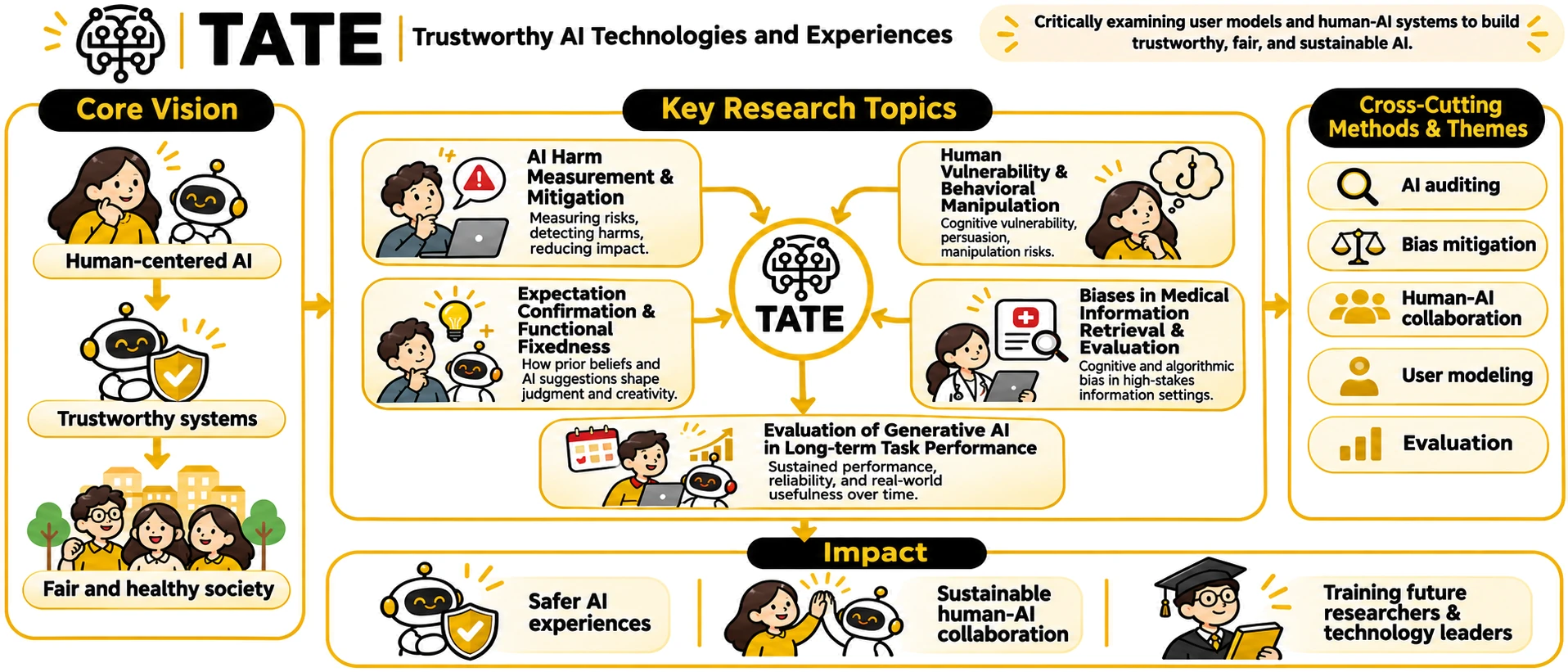
Proposed and developing activities
TATE also seeks to connect research in computing and AI with socially meaningful applications. Potential activities include interdisciplinary student research, postdoctoral research opportunities, community-engaged technology capstones, public-facing workshops on responsible AI, and student research showcases. We aim to develop collaborations across SOIS, UWM's College of Community Engagement and Professions, and external community and industry partners.
These activities are in development and are not currently funded programs. No postdoctoral positions are being advertised at this time.