Gauging Library Needs for Integrating Generative AI into Children's Maker Based Learning
Project Lead: PI: Dr. Jiqun Liu; Co PI: Dr. Yong Ju Jung
Graduate Students/Assistants: Mahdieh Nazari, Harun Karahan, Nischal Dinesh
Project Introduction
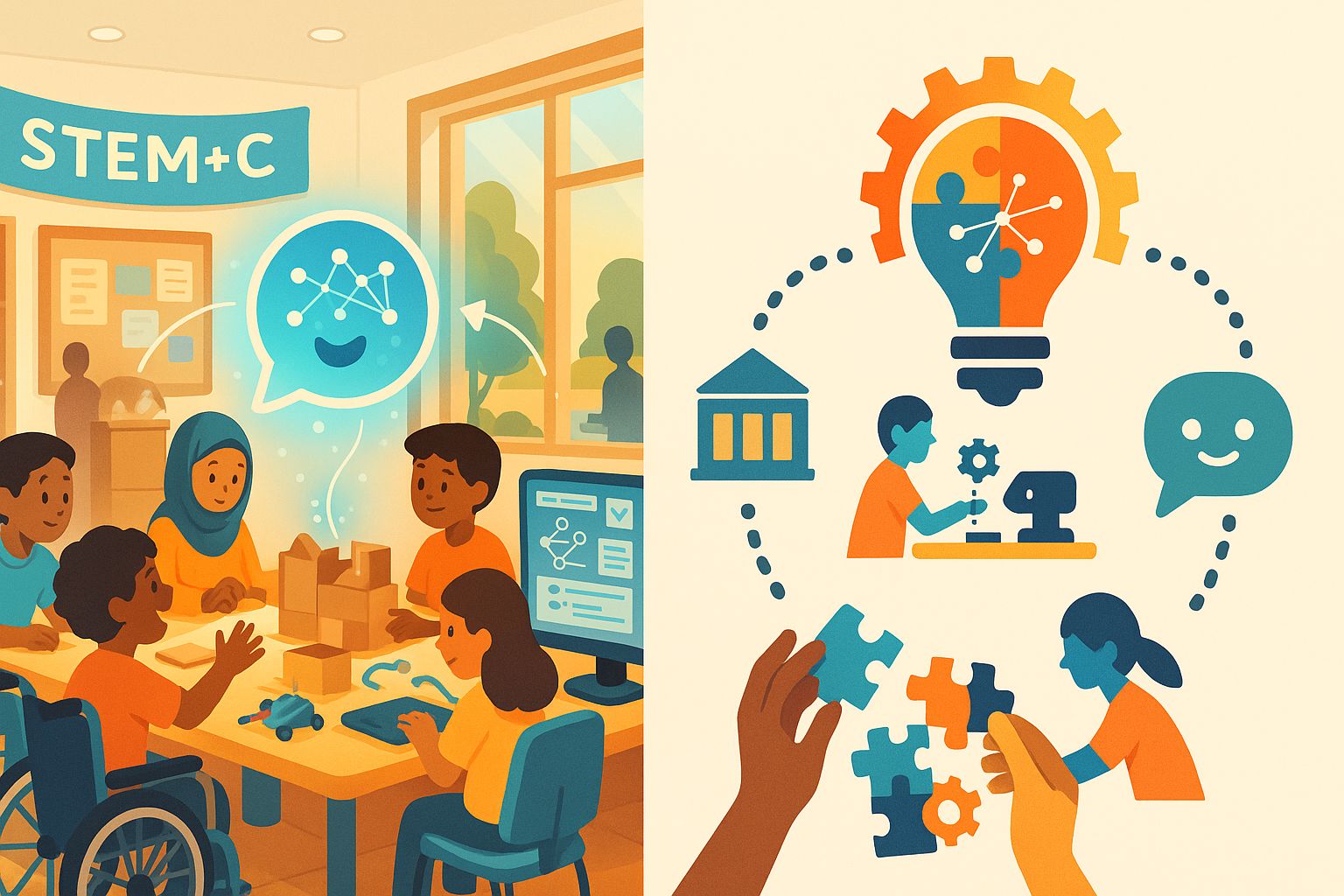
Public libraries play a vital role in supporting children's informal learning through hands on, creative, and community centered programs. Maker based activities in particular offer opportunities for young learners to explore problem solving, creativity, and technological thinking. At the same time, libraries face increasing pressure to respond to the rapid emergence of generative artificial intelligence, while navigating constraints related to staffing, ethics, and equitable access. This project examines how large language model enabled systems can be thoughtfully integrated into children's maker based learning in ways that strengthen, rather than replace, the educational role of library professionals.
This IMLS planning project (Award number: LG-257169-OLS) investigates how generative AI can support children's creativity, inquiry, and learning while aligning with the values of public libraries and the developmental needs of young learners. It centers on three research questions:
- What needs, opportunities, and constraints do library professionals and families identify regarding the use of generative AI in children's maker based learning?
- How can LLM enabled systems be designed to support creative exploration, problem solving, and AI literacy in developmentally appropriate and ethically responsible ways?
- How can public libraries effectively adopt, govern, and sustain these technologies while preserving their educational missions and community trust?
Methodology
The project employs a mixed methods, participatory research design conducted across multiple public libraries serving diverse communities. In the first phase, interviews and surveys with library professionals, children, and families will document existing maker practices, perceived challenges, and expectations surrounding AI supported learning. These findings will inform the design requirements and ethical considerations for subsequent phases.
In the second phase, the project will conduct participatory design workshops that bring together librarians, children, and researchers to co create concepts and low fidelity prototypes of AI supported maker activities. These sessions will explore how generative AI can assist with ideation, troubleshooting, reflection, and learning support while maintaining transparency, inclusivity, and age appropriate interaction. Training materials for library professionals will be developed in parallel to support responsible facilitation and oversight.
The final phase will pilot selected prototypes in participating libraries. Data collected through observations, system logs, and interviews will be used to evaluate usability, learning value, ethical implications, and implementation feasibility. Findings will guide refinements to both the tools and the associated training resources.
Timeline
The project will run from September 2025 through August 2027. The first year will focus on needs assessment in libraries, stakeholder engagement, and foundational design work. The second year will emphasize participatory design, prototype development, pilot deployment in partner libraries, and systematic evaluation of outcomes. This phased timeline ensures that design decisions and evaluation activities are grounded in real world contexts and iteratively refined through evidence.
Expected Deliverables
The project will produce several key outcomes. These include a comprehensive needs assessment documenting opportunities and challenges for integrating generative AI into children's maker based learning; a set of design guidelines and prototype tools co developed with library professionals and families; and practical training materials that support responsible and inclusive AI use in library settings. In addition, the project will generate empirical insights into how children, librarians, and communities interact with generative AI in informal learning environments. Together, these outputs will contribute actionable guidance for libraries nationwide, advance research on human centered and ethical AI in education, and establish a foundation for scalable, community informed approaches to AI supported learning and education for American youth.
Advisory Board Members
Caroline Flory
Caroline works in Maker + STEAM services in a public library. She has loved libraries since before she could read, and she enjoys incorporating science and arts and her background in kinesiology into accessible and creative programs. When not at the library, Caroline loves spending time with her kids (who love to read, too!) and her favorite people, reading, hiking, exploring, learning, and music.
Soo Hyeon Kim
Soo Hyeon Kim, Ph.D. is an Assistant Professor in the Department of Library and Information Science at Indiana University Indianapolis. Dr. Kim’s research spans across library makerspace, maker-based STEM learning in public libraries, and intergenerational participation. Her research aims to broaden and support children’s STEM learning opportunities by transforming public libraries and family interactions as facilitators for tech-supported maker experiences. She served as a principal investigator for IMLS-funded Family Makers project that involved rural librareis to co-design and implement engineering programs and has widely published in the field of library and information science and the learning sciences.
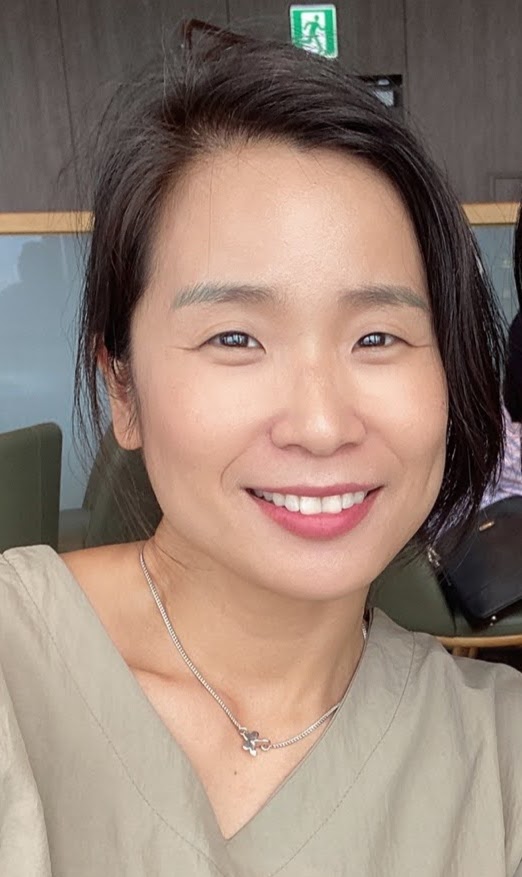
Hyewon Park
Hyewon Park, Ph.D., is a Research Data Analyst in the Department of Public Health Sciences at the UC Davis and affiliated with the Tobacco Control Evaluation Center (TCEC) as an Evaluation Associate. She has worked with digitalLIFT, a nonprofit organization that provides digital literacy training for adults, as a researcher and a digital literacy instructor. Her research focuses on digital literacy and healthy aging, AI literacy training, lifelong learning, and evaluation for organizational learning. She is passionate about supporting vulnerable communities and promoting lifelong learning and empowerment through digital learning initiatives. Hyewon earned her Ph.D. in Lifelong Learning and Adult Education from Pennsylvania State University.
Wendy Burnett
Jiangen He
Parter Library Representatives
Pioneer Library System SOKC Public Library
Christina Brady is the Children's Department Manager at the SOKC Branch of the Pioneer Library System. She holds a Master of Education in Curriculum and Instruction from the University of Montana and a Master of Library and Information Science from San José State University. Christina has served as a public librarian since 2015, fostering a love of learning and literacy in her community.